Adversarial AutoEncoder

Adversarial Autoencoder

ref1 gocha good one

无监督AAE

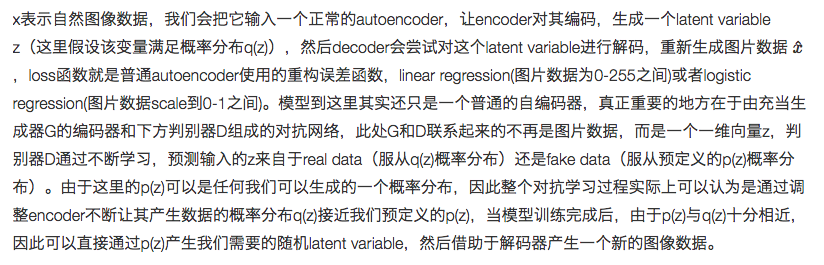
autoencoder中的encoder的输出(潜在码)并不能在某一特定空间均匀分布,而且AE 的 G 只能保证将由 x 生成的 z 还原为 x。如果我们随机生成 1 个 z,经过 AE 的 G 后往往不会得到有效的图像。

所以我们希望encoder的输出可以服从某一分布,这个分布可以是正态分布,均匀分布等,这样就会使encoder的输出均匀分布在给定的先验分布,使decoder学习到一个先验分布到输入数据的映射(本例中就是学习到MNIST手写体数据的分布),那么此时只需从这个先验分布采样出 z,就能通过 G 得到有效的图像。

假设你正在学习一门课程,如果你的老师并没有提供任何资料,你又会如何学习这门课呢?但是考试怎么办呢,难道要自己瞎答吗?这种情况就是类似我们的encoder的输出并不服从某种特定分布,这样decoder就无法学习到一个从任意数字到图片的映射。

但是如果你有了一个课程指导书,你就可以在考试之前复习这本书,这样就知道了可能的考试内容。类似的,如果我们的encoder输出服从一个已知分布,那么encoder就会将潜在码覆盖整个先验分布。

模型
Screen-Shot-2016-10-13-at-11.17.21-AM-690x332

Screen Shot 2018-08-08 at 9.33.36 PM

1_nnf4UUq9Uuf2l19iCYaNfg

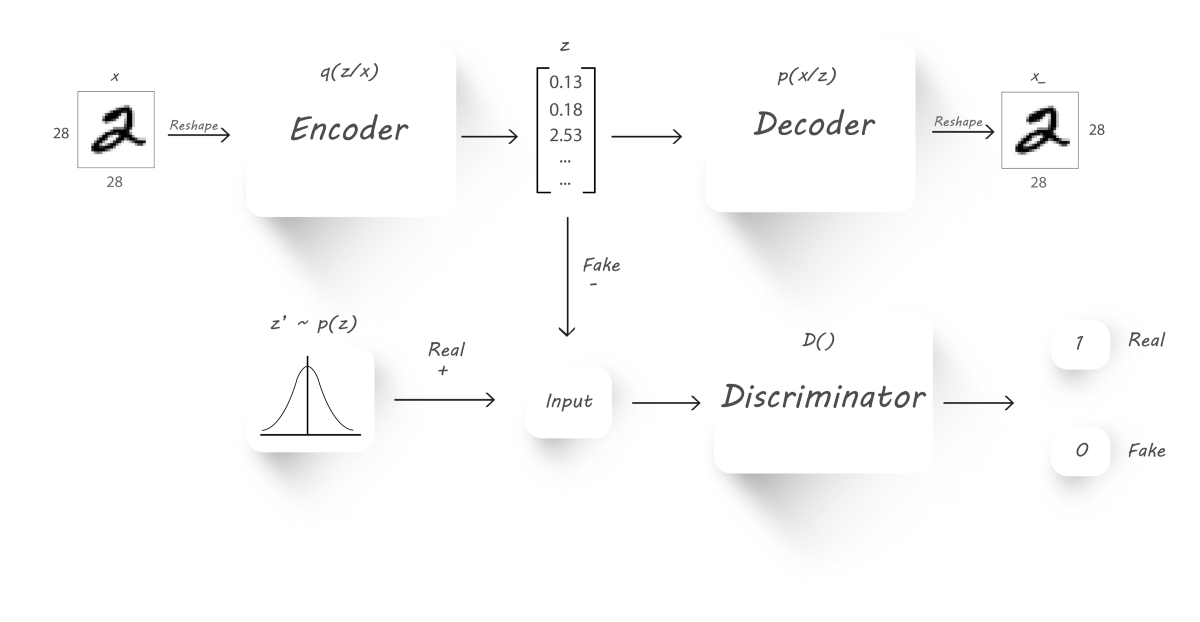
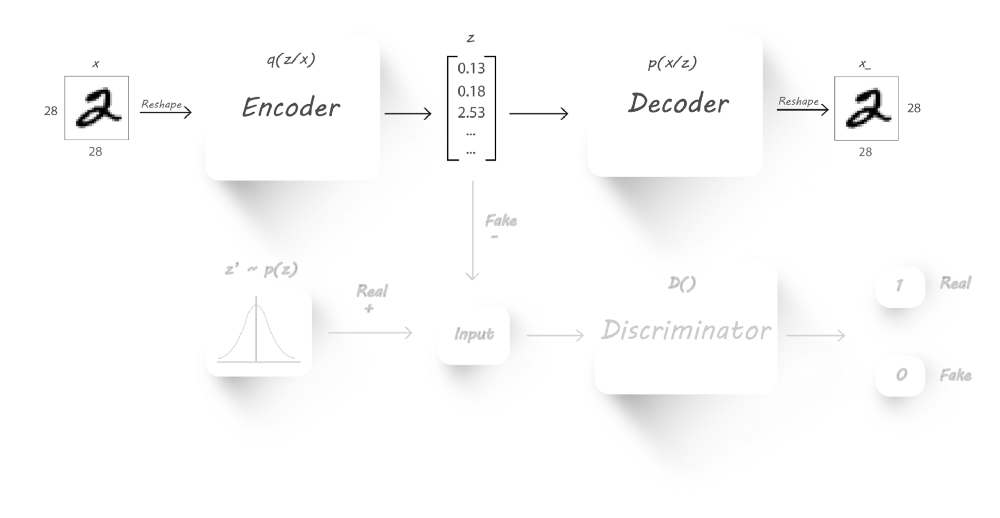
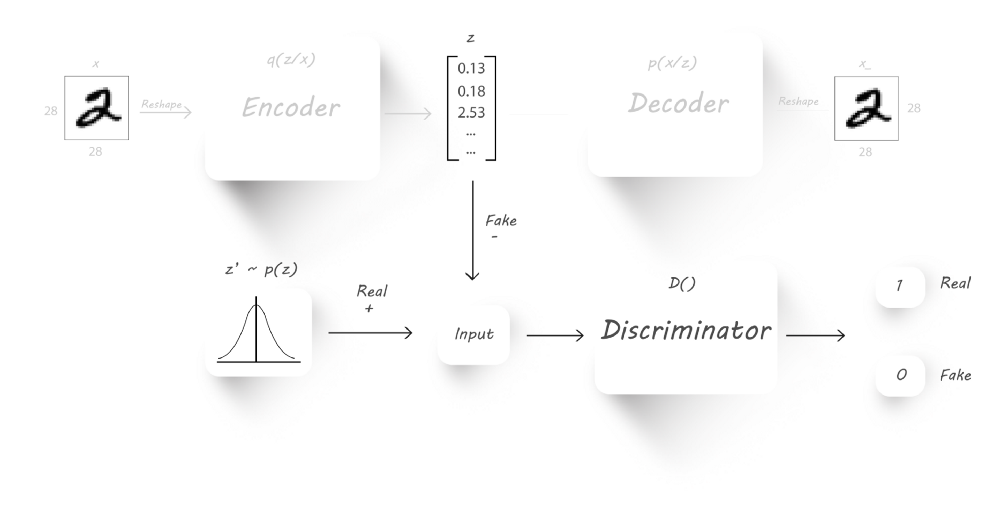
  • $x$是输入
  • $q(z|x)$是encoder基于输入$x$的输出
  • $z$是潜在码,同时也是一个假输入,从$q(z|x)$中采样得到
  • $z’$是采样自想要的分布,作为真实输入
  • $p(x|z)$是基于$z$的decoder输入
  • $x_$是重构图像

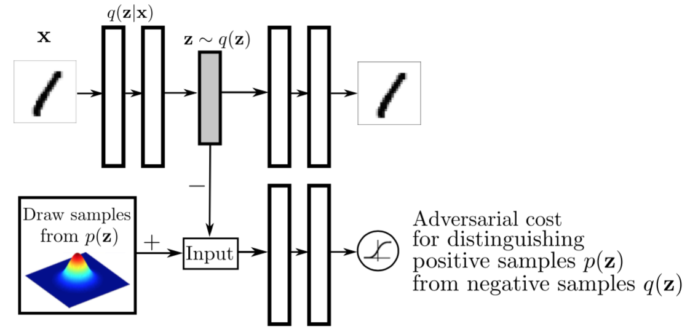
我们的主要目的是迫使encoder的输出逼近一个先验分布(比如正态分布,gamma分布等)。我们将使用encoder$(q(z|x))$作为生成器,而判别器辨别它的输入是来自于一个先验分布$p(z)$,亦或是来自于encoder的输出$z$,decoder仍然进行图片重构的工作。

训练

AAE的训练分成两个部分:重构阶段和正则化阶段。

训练上述模型,分成两个阶段:一个是对辨别器的训练;另一个是对GAN模型的训练。

对于分辨器,其输入就是真假latent code,输出real概率

对于GAN模型,它需要配合分辨器来完成训练。encoder-decoder产生两个输出:一个是latent code,一个是image,但是我们只需要latent code作为分辨器的输入,从而完成GAN模型的训练。

重构阶段
1_DKPl7YOnX-8FJQuHAZop-g

在该阶段,我们需要训练encoder和decoder来最小化重构误差(输入图片与重构图片间的均方误差)。我们将输入传递给encoder,encoder输出一个潜在码;随后,我们将该潜在码送入decoder从而得到一张重构图像。

正则化阶段
1__pIXKcCCqJRNmIWTRymJzA

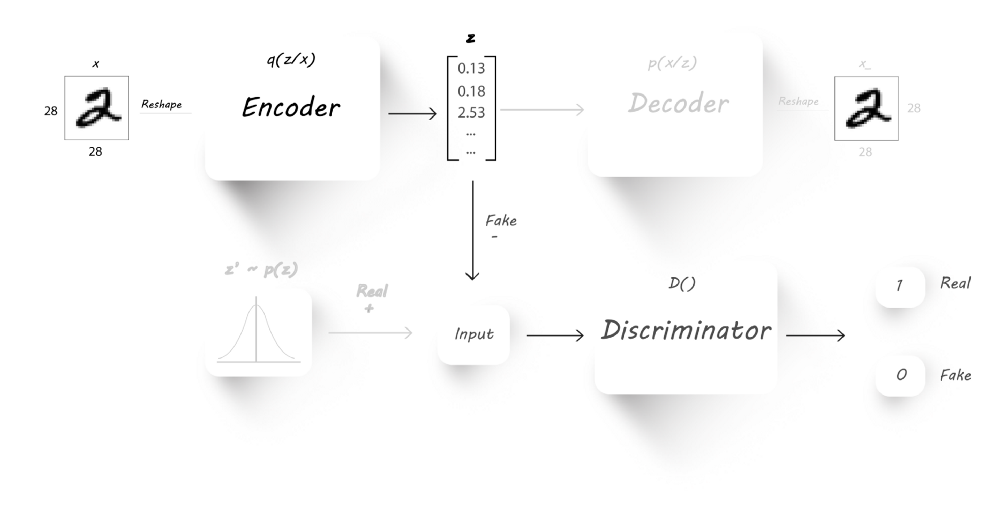
在该阶段,我们训练生成器和辨别器,我们将encod的输出$z$和随机采样$z’$(来自于想要的分布)作为输入来训练辨别器,这样辨别器就会返回1如果输入是$z’$,而返回0如果输入是$z$。接下来,为了迫使encoder的输出$z$逼近我们想要的分布,我们将encoder的输出作为辨别器的输入,连接encoder和辨别器。
1_DoJESN2LvxpxNVYADRJXWw

我们固定辨别器的权重参数,固定输入的目标标签为1,然后我们输入一些图像到encoder,并计算辨别器的输出与目标标签间的差异(使用交叉熵损失函数),这个阶段我们只更新encoder的权重参数,这样促使encoder去学习我们想要的分布,使输出服从这个分布。

Python实现

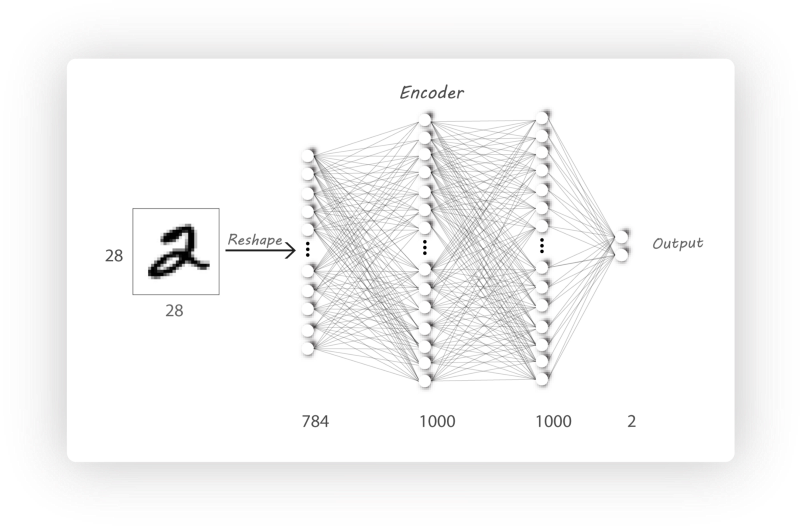
Encoder构造
1_Hud7t2vLY2JIP3SXn4WTDA

点击显/隐内容
1
2
3
4
5
6
7
8
9
10
11
def make_encoder(self):
input_img = Input(self.input)
h = Flatten()(input_img)
h = Dense(1000,activation='relu')(h)
mean = Dense(2)(h)
logvar = Dense(2)(h)
z = Lambda(self.sampling, output_shape=(self.latent_dim,))([mean, logvar])
encoder = Model(input_img,z)
encoder.summary()
return encoder
1
2
3
4
def sampling(self, args):
z_mean, z_log_sigma = args
epsilon = K.random_normal(shape=(K.shape(z_mean)[0], self.latent_dim), mean=0., stddev=1.0)
return z_mean + K.exp(z_log_sigma / 2) * epsilon

Decoder构造

1_0t7JrvUqyzg7AdQGDjZkRw

点击显/隐内容
1
2
3
4
5
6
7
8
9
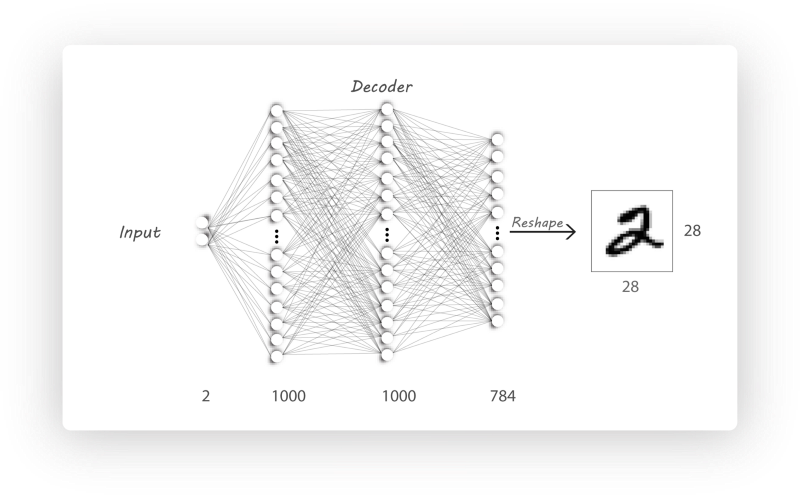
def make_decoder(self): # ok
input_code = Input((self.latent_dim,))
h = Dense(1000,activation='relu')(input_code)
h = Dense(1000,activation='relu')(h)
h = Dense(784,activation='sigmoid')(h)
recon_img = Reshape(self.input)(h)
decoder = Model(input_code,recon_img)
decoder.summary()
return decoder

Discriminator构造

1_Df3_l66beZqsqRe5i6lZRw

点击显/隐内容
1
2
3
4
5
6
7
8
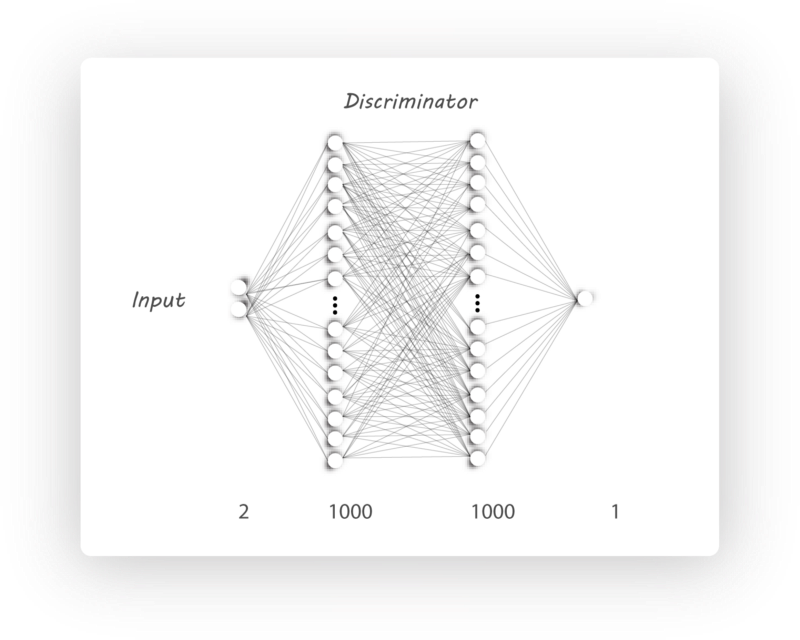
def make_discriminator(self): # ok
input_code = Input((self.latent_dim,))
h = Dense(1000,activation='relu')(input_code)
h = Dense(1000,activation='relu')(h)
valid = Dense(1)(h)
discriminator = Model(input_code,valid)
discriminator.summary()
return discriminator

GAN的构造与编译

点击显/隐内容
1
2
3
4
5
6
7
8
9
10
11
12
13
14
15
16
17
18
19
20
21
22
23
24
25
26
27
28
29
class aae():
def __init__(self):
self.input = (28,28,1)
self.latent_dim = 2
optimizer = Adam(lr=0.0002,beta_1=0.5)
# Build and compile the discriminator
self.discriminator = self.make_discriminator()
self.discriminator.compile(optimizer=optimizer,
loss=['binary_crossentropy'],
metrics=['accuracy'])
# Build the encoder / decoder
self.encoder = self.make_encoder()
self.decoder = self.make_decoder()
image = Input(self.input)
latent_code = self.encoder(image)
recon_img = self.decoder(latent_code)
# for the adversarial_autoencoder model, we only train the generator
self.discriminator.trainable = False
valid = self.discriminator(latent_code)
# The adversarial_autoencoder model (stacked generator and discriminator)
self.adversarial_autoencoder = Model(image,[recon_img,valid])
self.adversarial_autoencoder.compile(loss=['mae','binary_crossentropy'],
loss_weights=[0.999,0.001],
optimizer=optimizer)
1
2
3
4
5
6
7
8
9
10
11
12
13
14
15
16
17
18
19
20
21
22
23
24
25
26
27
def train(self,epoches=1000,batch_size=100):
# Load the dataset
(X_train, _), (_, _) = mnist.load_data()
# Configure input
X_train = (X_train.astype(np.float32) - 127.5) / 127.5 # pixel between [-1,1]
X_train = np.expand_dims(X_train, axis=3) # change shape from (60000,28,28) to (60000,28,28,1)
# Adversarial ground truths
valid = np.ones((batch_size, 1))
fake = np.zeros((batch_size, 1))
for epoch in range(1,epoches+1):
# Select a random half batch of images
idx = np.random.randint(0, X_train.shape[0], batch_size)
imgs = X_train[idx]
latent_fake = self.encoder.predict(imgs)
latent_real = np.random.normal(0, 1, (batch_size, 2))
# train the discriminator
d_loss_real = self.discriminator.train_on_batch(latent_real, valid)
d_loss_fake = self.discriminator.train_on_batch(latent_fake, fake)
d_loss = 0.5 * np.add(d_loss_real, d_loss_fake)
# train the generator
g_loss = self.adversarial_autoencoder.train_on_batch(imgs, [imgs, valid])
print("%d [D loss: %f, acc: %.2f%%] [G loss: %f, mse: %f]" % (
epoch, d_loss[0], 100 * d_loss[1], g_loss[0], g_loss[1]))
1
2
3
if __name__ == '__main__':
model = aae()
model.train()

监督AAE

Disentanglement of style and content

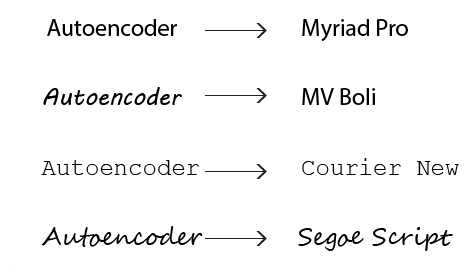
对于一个写作主题,每一个人写出来的文章都有不同的内容(content)和字体(style)。对于MNIST字体,可以发现它的所有图像都有一样的style,所以我们想要从这个数据集中学习MNIST字体的style。为了更明确content和style的区别,我们有如下图:
Screen Shot 2018-08-28 at 11.39.06 AM

每个文本都有相同的content “Autoencoder”,但是它们的字体是不一样的,现在我们想要从图片中去区分style(Myriad Pro, MV Boil,…)和content,特征分离是表征学习(representation learning)的一个重要内容。

Autoencoder和Adversarial Autoencoder都是无监督学习,因为在训练过程中我们并没有世人任何label信息,但是如果利用图片的label信息则会帮助AAE去提取style信息而不受图片content的影响,这样我们的AAE就变成了一个监督模型。

模型
1_vGU0REkvre1DI7sFLU97_g

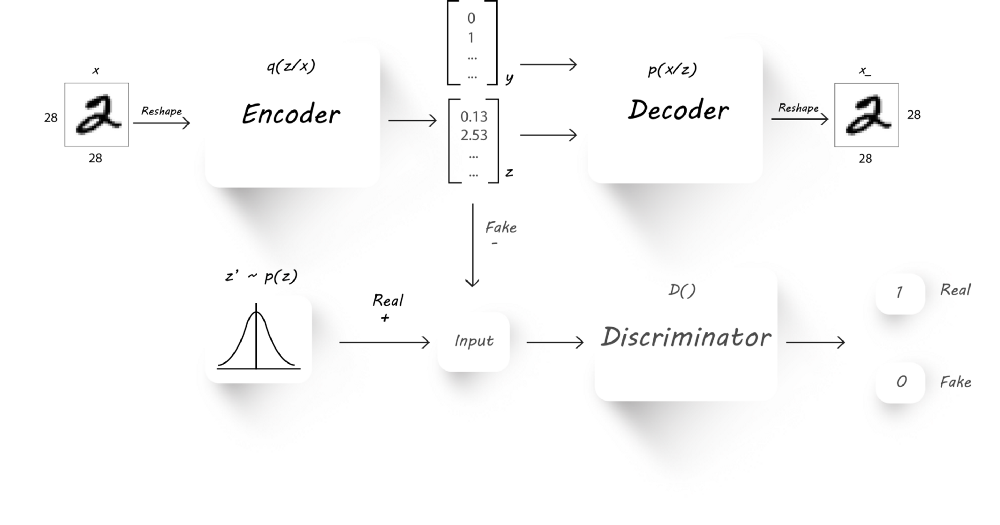
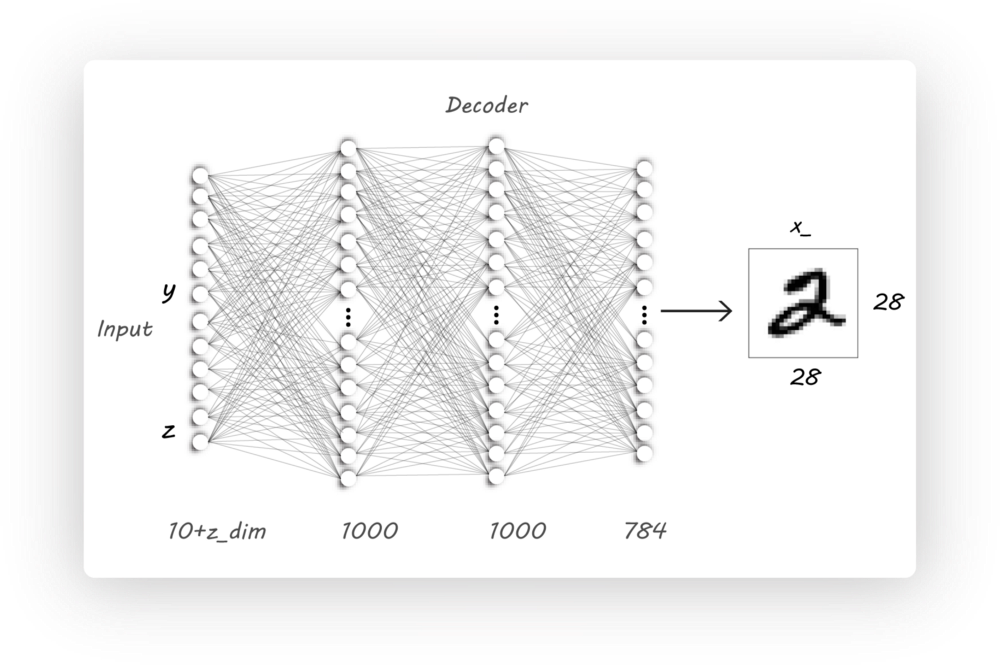
除了利用latent code作为decoder的输入,我们同时把标签y信息作为另一个输入,decoder利用这两个输入来生成图片。encoder学习图片的style,decoder利用该学习到的style和额外的内容信息y来重构输入图片

相比较于无监督AAE,唯一的区别就是decoder的输入:

  • 来自encoder的latent code
  • 图像标签的独热表示

训练

重构阶段

我们将输入图像送入encoder得到输出latent codez,然后将z和图像标签y串接起来成为一个更大的输入送入decoder。我们训练AE使最小化图片重构损失

正则化阶段

与无监督 AAE一样。

Python实现

Decoder
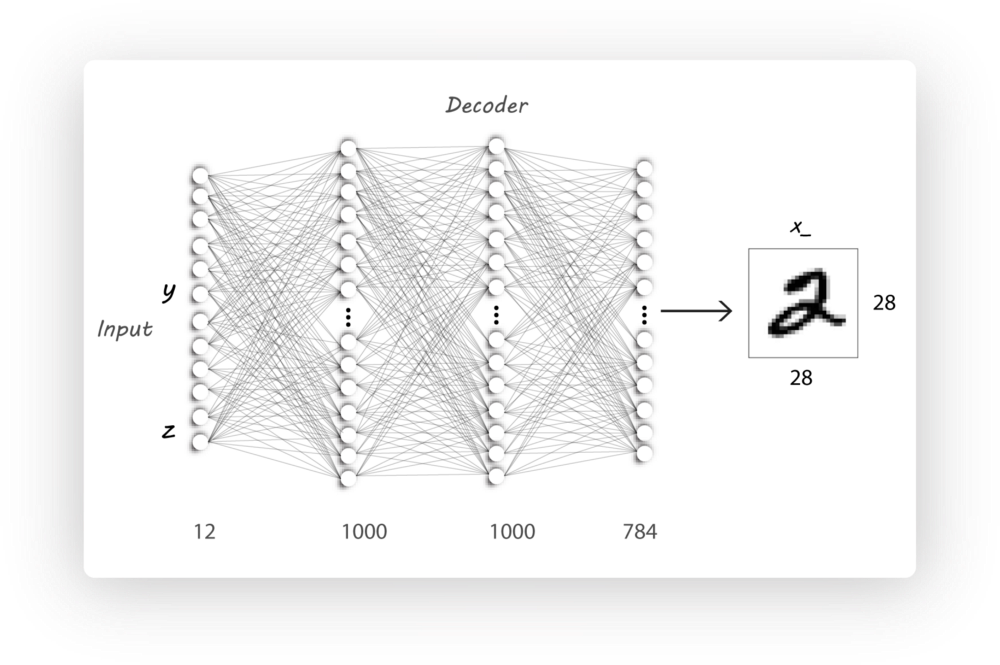
1_lzIl05QPdy-aEtVvh-y1LQ

MNIST的图像总共有10类,则y的独热向量长度就是10,laten code的长度是2,则decoder的输入长度是(10+2)

点击显/隐内容
1
2
3
4
5
6
7
8
9
10
11
12
13
14
15
16
17
18
19
20
21
22
23
24
25
26
27
28
29
30
31
32
33
34
35
36
37
38
39
40
41
42
43
44
45
46
47
48
49
50
51
52
53
54
55
56
57
58
59
60
61
62
63
64
65
66
67
68
69
70
71
72
73
74
75
76
77
78
79
80
81
82
83
84
85
86
87
88
89
90
91
92
93
94
95
96
97
98
99
100
101
102
103
104
105
106
107
108
109
110
111
112
113
from keras.datasets import mnist
from keras.layers import Input, Dense, Reshape, Flatten, Dropout, multiply
from keras.layers import BatchNormalization, Embedding, Lambda,Concatenate
from keras.layers.advanced_activations import LeakyReLU
from keras.models import Sequential, Model
from keras.optimizers import Adam
from keras import backend as K
import keras
import matplotlib.pyplot as plt
import os
import numpy as np
class aae():
def __init__(self):
self.input = (28,28,1)
self.latent_dim = 15
self.classes = 10
optimizer = Adam(lr=0.0002,beta_1=0.5)
# Build and compile the discriminator
self.discriminator = self.make_discriminator()
self.discriminator.compile(optimizer=optimizer,
loss=['binary_crossentropy'],
metrics=['accuracy'])
# Build the encoder / decoder
self.encoder = self.make_encoder()
self.decoder = self.make_decoder()
image = Input(self.input)
label = Input((self.classes,))
latent_code = self.encoder(image)
recon_img = self.decoder([label,latent_code])
# for the adversarial_autoencoder model, we only train the generator
self.discriminator.trainable = False
valid = self.discriminator(latent_code)
# The adversarial_autoencoder model (stacked generator and discriminator)
self.adversarial_autoencoder = Model([image,label],[recon_img,valid])
self.adversarial_autoencoder.compile(loss=['mse','binary_crossentropy'],
loss_weights=[0.999,0.001],
optimizer=optimizer)
def sampling(self, args):
z_mean, z_log_sigma = args
epsilon = K.random_normal(shape=(K.shape(z_mean)[0], self.latent_dim), mean=0., stddev=1.0)
return z_mean + K.exp(z_log_sigma / 2) * epsilon
def make_encoder(self):
input_img = Input(self.input)
h = Flatten()(input_img)
h = Dense(1000,activation='relu')(h)
mean = Dense(self.latent_dim)(h)
logvar = Dense(self.latent_dim)(h)
z = Lambda(self.sampling, output_shape=(self.latent_dim,))([mean, logvar])
encoder = Model(input_img,z)
encoder.summary()
return encoder
def make_decoder(self): # ok
input_code = Input((self.latent_dim,))
input_label = Input((self.classes,))
combine_input = Concatenate(axis=-1)([input_label, input_code])
h = Dense(1000,activation='relu')(combine_input)
h = Dense(1000,activation='relu')(h)
h = Dense(784,activation='sigmoid')(h)
recon_img = Reshape(self.input)(h)
decoder = Model([input_label,input_code],recon_img)
decoder.summary()
return decoder
def make_discriminator(self): # ok
input_code = Input((self.latent_dim,))
h = Dense(1000,activation='relu')(input_code)
h = Dense(1000,activation='relu')(h)
valid = Dense(1)(h)
discriminator = Model(input_code,valid)
discriminator.summary()
return discriminator
def train(self,epoches=1000,batch_size=100):
# Load the dataset
(X_train, y_train), (_, _) = mnist.load_data()
# Configure input
X_train = (X_train.astype(np.float32) - 127.5) / 127.5 # pixel between [-1,1]
X_train = np.expand_dims(X_train, axis=3) # change shape from (60000,28,28) to (60000,28,28,1)
y_train = y_train.reshape(-1, 1)
# Adversarial ground truths
valid = np.ones((batch_size, 1))
fake = np.zeros((batch_size, 1))
for epoch in range(1,epoches+1):
# Select a random half batch of images
idx = np.random.randint(0, X_train.shape[0], batch_size)
imgs = X_train[idx]
labels = y_train[idx]
labels = keras.utils.to_categorical(labels,self.classes)
latent_fake = self.encoder.predict(imgs)
latent_real = np.random.normal(0, 5., (batch_size, self.latent_dim))
# train the discriminator
d_loss_real = self.discriminator.train_on_batch(latent_real, valid)
d_loss_fake = self.discriminator.train_on_batch(latent_fake, fake)
d_loss = 0.5 * np.add(d_loss_real, d_loss_fake)
# train the generator
g_loss = self.adversarial_autoencoder.train_on_batch([imgs,labels], [imgs, valid])
print("%d [D loss: %f, acc: %.2f%%] [G loss: %f, mse: %f]" % (
epoch, d_loss[0], 100 * d_loss[1], g_loss[0], g_loss[1]))
if __name__ == '__main__':
model = aae()
model.train()

GAN分类器

ref

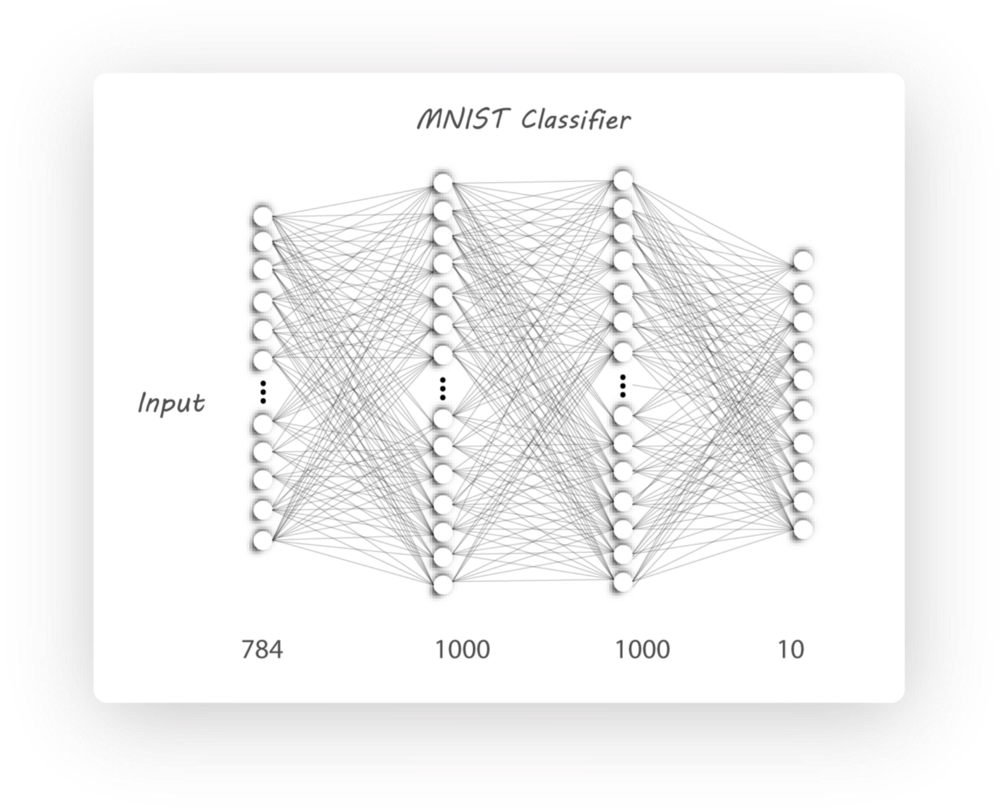
本节我们将介绍如何利用encoder对MNIST手写体进行分类,并与传统的神经网络分类器(NN)比较,为保证实验公平性,encoder和NN使用相同的结构。

我们首先介绍传统的NN分类器,如下图所示,
1_OPtU8py5KBpbVUZKylGDPA

点击显/隐内容

那么我们如何将encoder改造成为一个分类器呢?实际上,encoder分类器不仅能够提升分类准确率,还可以减少数据维度,从图片中分离内容和风格,我们的模型如下:
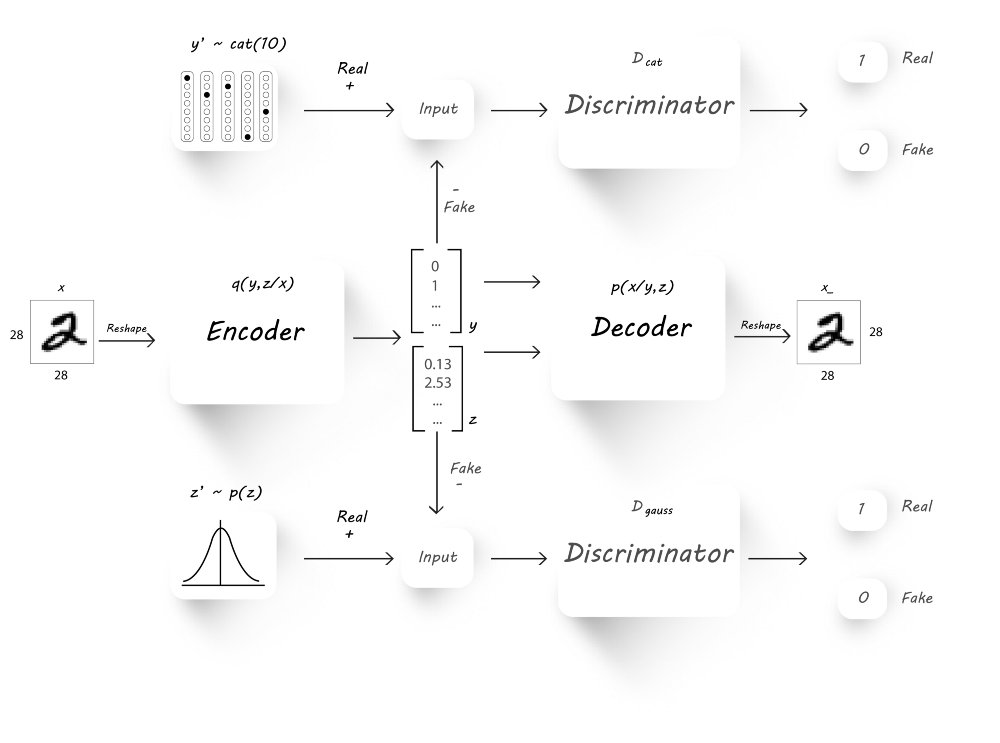
1_8RuZ8kguLuosOGoDpiSgUQ

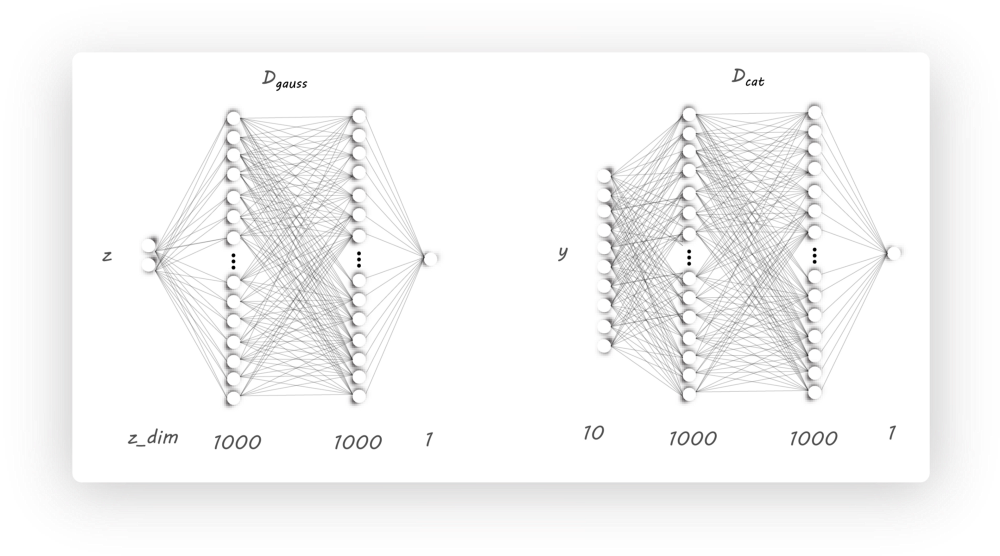
可以看到,我们增加了额外的discriminator($D_{cat}$),该分类器以对抗的方式与encoder一起训练,从而迫使encoder产生10维的独热分类向量

在AAE的基础上对encoder作了修改,此时encoder有两个输出:latent code(z)和classification(y),由于有10个类,则y为10维向量,而z的维度由用户决定。

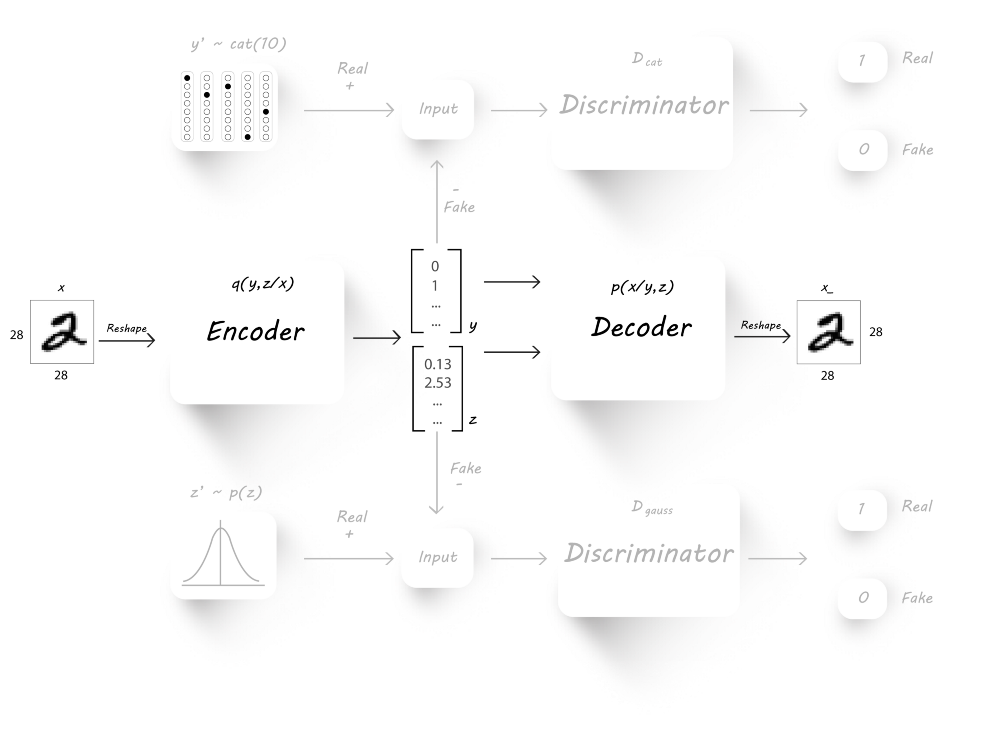
图片重构阶段
1_onLoFTa8qcFMdgm9ILKDaw

该阶段我们欲使生成的图片逼近我们的真实图片,所以我们使用MSE(mean squared error)来衡量输入图片与输出图片间的差异。

正则化阶段

该阶段由两个部分组成:$D_{cat}$和$D_{gauss}$的训练
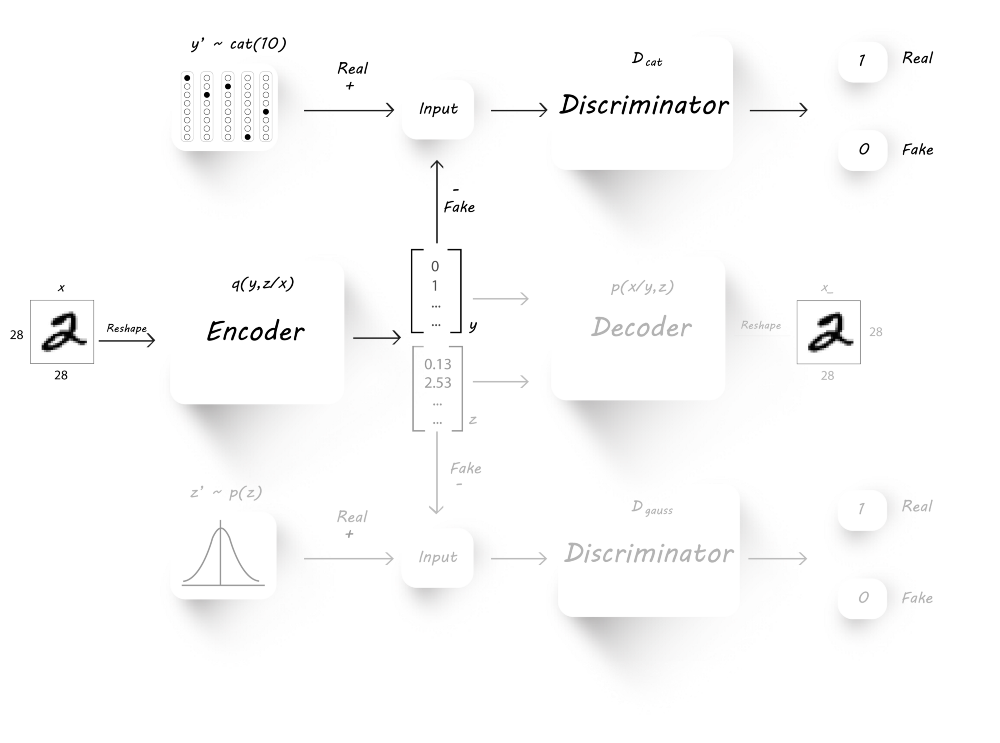
1_HKvMbwaXmDAg12GjgOC39Q

我们首先训练discriminator D_cat来辨别真实的分类标签$y^{‘}$和encoder生成的分类标签$y$。为此,我们将图片作为encoder的输入取产生$y$和$z$,然后将生成的$y$和真实的$y^{‘}$用于discriminator的训练。最后,我们固定分辨器的参数,并设置目标为1,训练encoder来欺骗分辨器。
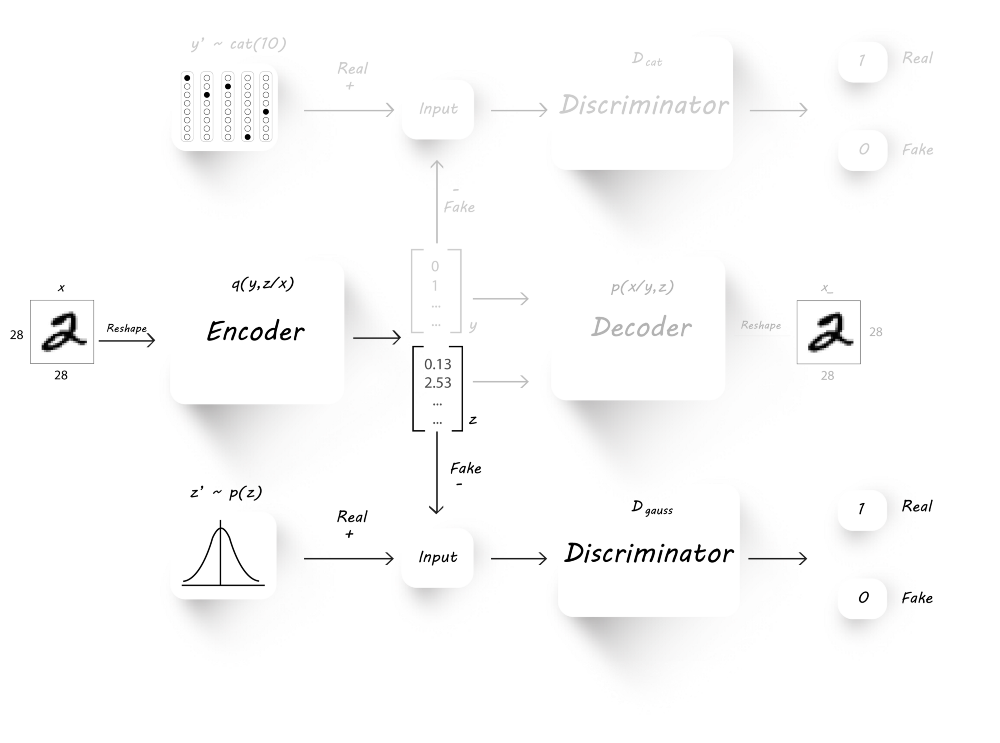
1_qMGBvI2q14lNKGMrx_gMnw

同样的,为了生成具有高斯分布的latent code(z),我们还需要训练分辨器$D_{gauss}$。

半监督分类器阶段
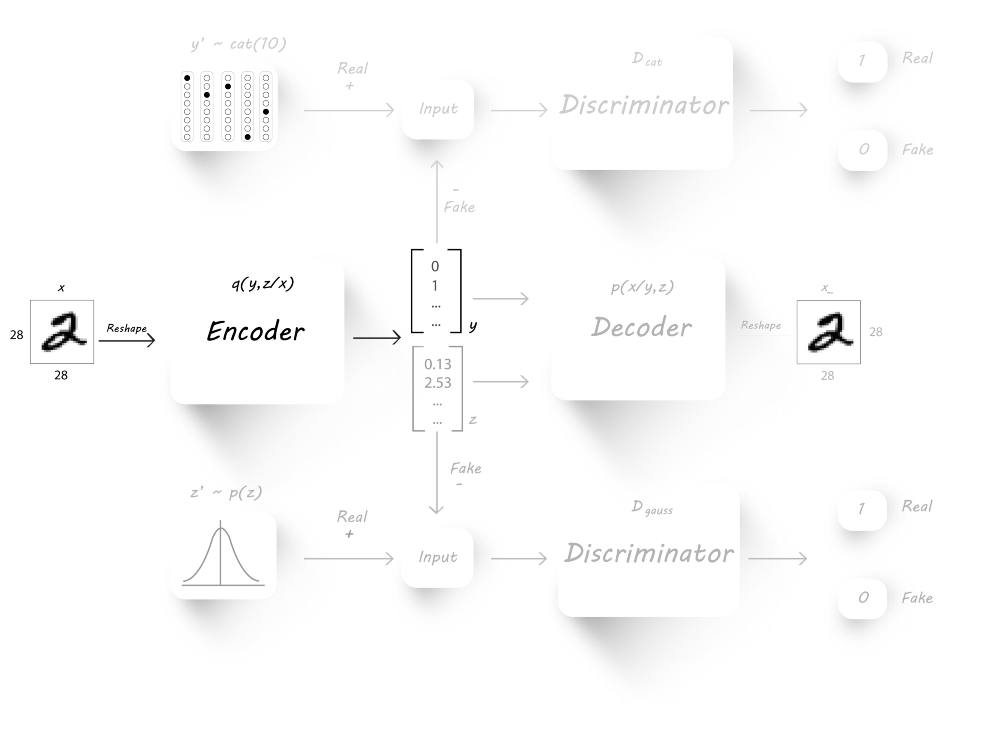
1_ZS7wa7H8tHUDWkuqGZJT2Q

最终我们训练encoder来对手写体数字进行分类,目的是最小化生成的分类标签与真实的标签的交叉熵。

Python实现

Encoder
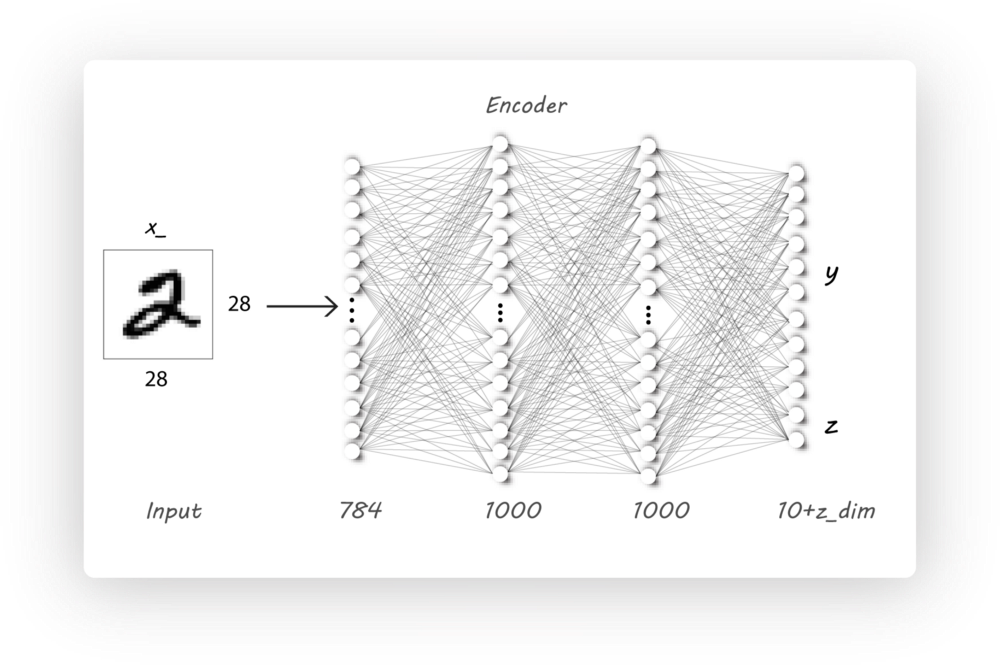
1_qufKKgKUPUGvYKWsmqiv5w

在原始encoder的基础上,只需要需改encoder的输出维度,增加对分类标签的输出

Decoder
1_nRF013A75pCdlgOT48w0MA

Discriminator

1_jzDB_IJhVL74Zb0NU03Uew

我们需要两个分辨器,它们除了输入维度不同,其他是一样的

点击显/隐内容

CVAE-GAN

REF1

《 CVAE-GAN: Fine-Grained Image Generation through Asymmetric Training》

点击显/隐内容